

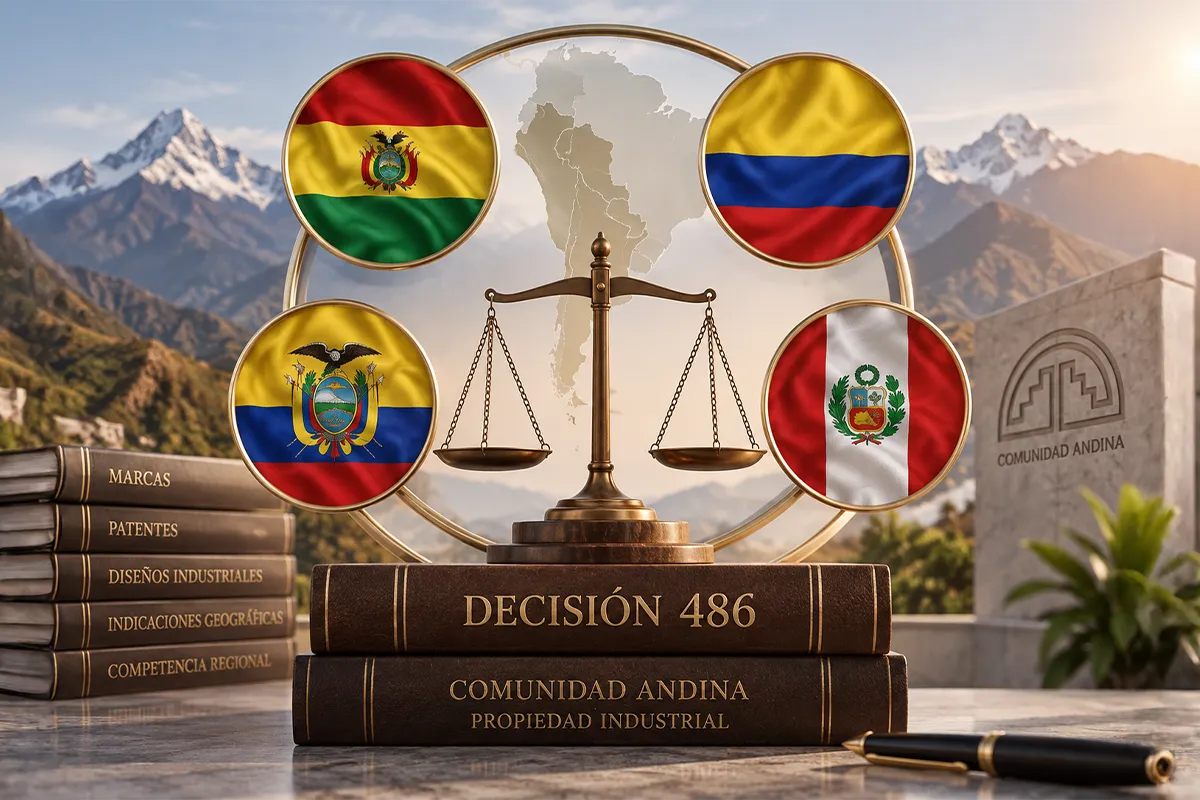
Decision 486 of the Commission of the Andean Community, in force since December 2000, establishes the Common Industrial Property Regime applicable in Bolivia, Colombia, Ecuador and Peru. It is one of the most significant examples of regional integration in the field of Industrial Property in Latin America and provides common rules governing trademarks, patents, utility models, industrial designs, geographical indications and other rights.
For owners of international Industrial Property portfolios, Decision 486 offers a particularly important advantage: although rights continue to be granted and administered by the national IP offices of each country, certain provisions allow rights or activities existing in one Member Country to have legal effects in another.
Two particularly relevant examples are Andean oppositions and the possibility of relying on evidence of trademark use in any Andean Community Member Country to defend a registration against a non-use cancellation action.
Andean Oppositions: Protection Beyond National Borders
One of the most interesting features of Decision 486 is the so-called “Andean opposition.”
Article 147 allows, subject to certain requirements, an opposition to be filed against a trademark application in one Member Country on the basis of an identical or similar trademark previously applied for or registered in another Andean Community Member Country. Decision 486 therefore introduces an important exception to, or qualification of, the traditional principle of territoriality of trademark rights.
For example, the owner of a trademark registered in Colombia, even if it does not yet own a registration in Peru, may rely on that right as the basis for opposing a conflicting trademark application filed in Peru.
There is, however, an important requirement: the opponent must demonstrate a real interest in the market of the country in which the opposition is filed. For this purpose, the opponent must apply for registration of its trademark in that country at the time the opposition is filed.
This mechanism can be particularly useful for international companies gradually expanding their activities throughout the region, as it enables them to take action against potentially conflicting applications even when their trademark portfolios have not yet been fully developed in all Andean countries.
An Additional Advantage in Non-Use Cancellation Actions
Andean integration provides another particularly valuable tool for trademark owners.
Under Article 165 of Decision 486, a trademark may be subject to cancellation when, without justified reason, it has not been used during the three consecutive years preceding the commencement of the cancellation action. However, the provision does not necessarily require the trademark to have been used in the country where it is registered: it is sufficient to establish genuine use in at least one of the Andean Community Member Countries.
Thus, for example, when defending a cancellation action against a Peruvian trademark registration, the owner may submit evidence of use from Colombia, Ecuador or Bolivia, provided that such use meets the requirements established under Andean law.
Articles 166 and 167 supplement this rule by establishing the criteria for determining trademark use and the means by which such use may be proven. Relevant evidence may include commercial invoices, accounting records and audit certificates demonstrating the regularity and volume of commercialization. Decision 486 also recognizes certain exports from a Member Country as qualifying use.
This possibility is of considerable practical importance for companies managing regional trademark portfolios. A product may, for example, no longer be temporarily marketed in Peru while continuing to be effectively commercialized in Colombia. Subject to the requirements of Decision 486, such use may be relied upon to maintain the Peruvian registration against a non-use cancellation action.
A Regional Approach to Trademark Protection
These provisions demonstrate that trademark protection within the Andean Community should not be considered exclusively from a national perspective.
Although there is no single “Andean trademark registration”—trademark rights continue to be applied for and granted on a country-by-country basis—Decision 486 creates important links between the legal systems of Bolivia, Colombia, Ecuador and Peru. The ability to file oppositions based on rights existing in another Member Country and to rely on use occurring elsewhere within the Andean territory are two clear examples.
For international trademark owners, this creates opportunities to develop more efficient regional strategies: a properly structured portfolio of rights within the Andean Community can provide enforcement and defensive tools that extend beyond the borders of each individual country.
At Estudio Colmenares & Asociados, with more than 120 years of experience in Industrial Property in Peru, we advise domestic and international rights holders on the development, protection and enforcement of their Industrial Property portfolios, including strategies involving the application of Decision 486 and the Andean Community legal framework.